

A Basic Ontology of Internet Aesthetics: Methods and Categories
BASIC TAXONOMY
Definition of "Aesthetic"
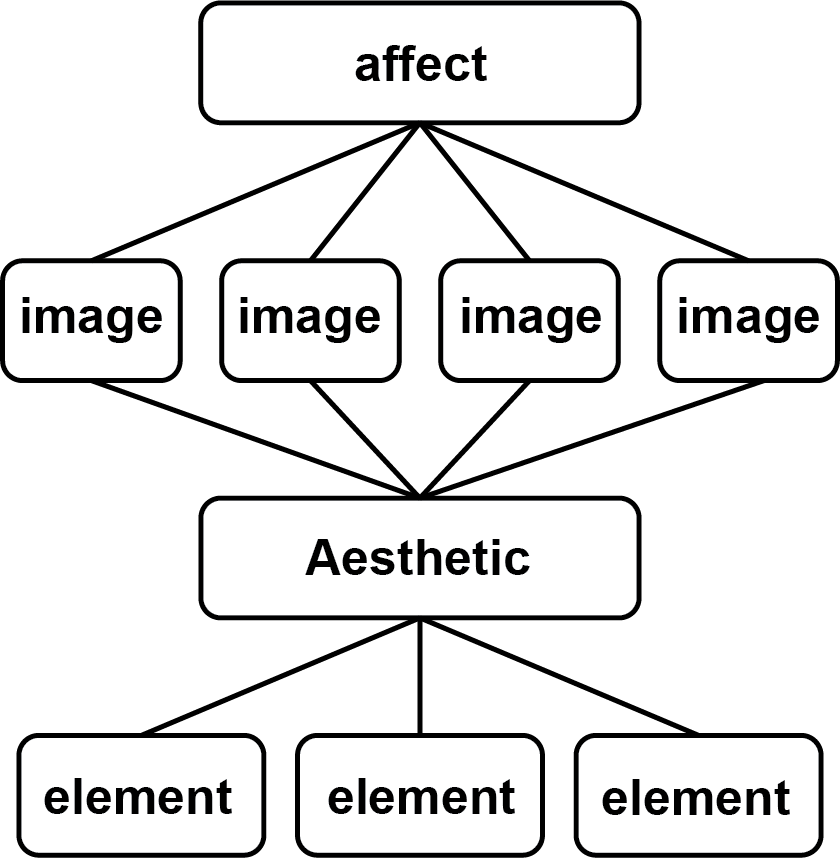
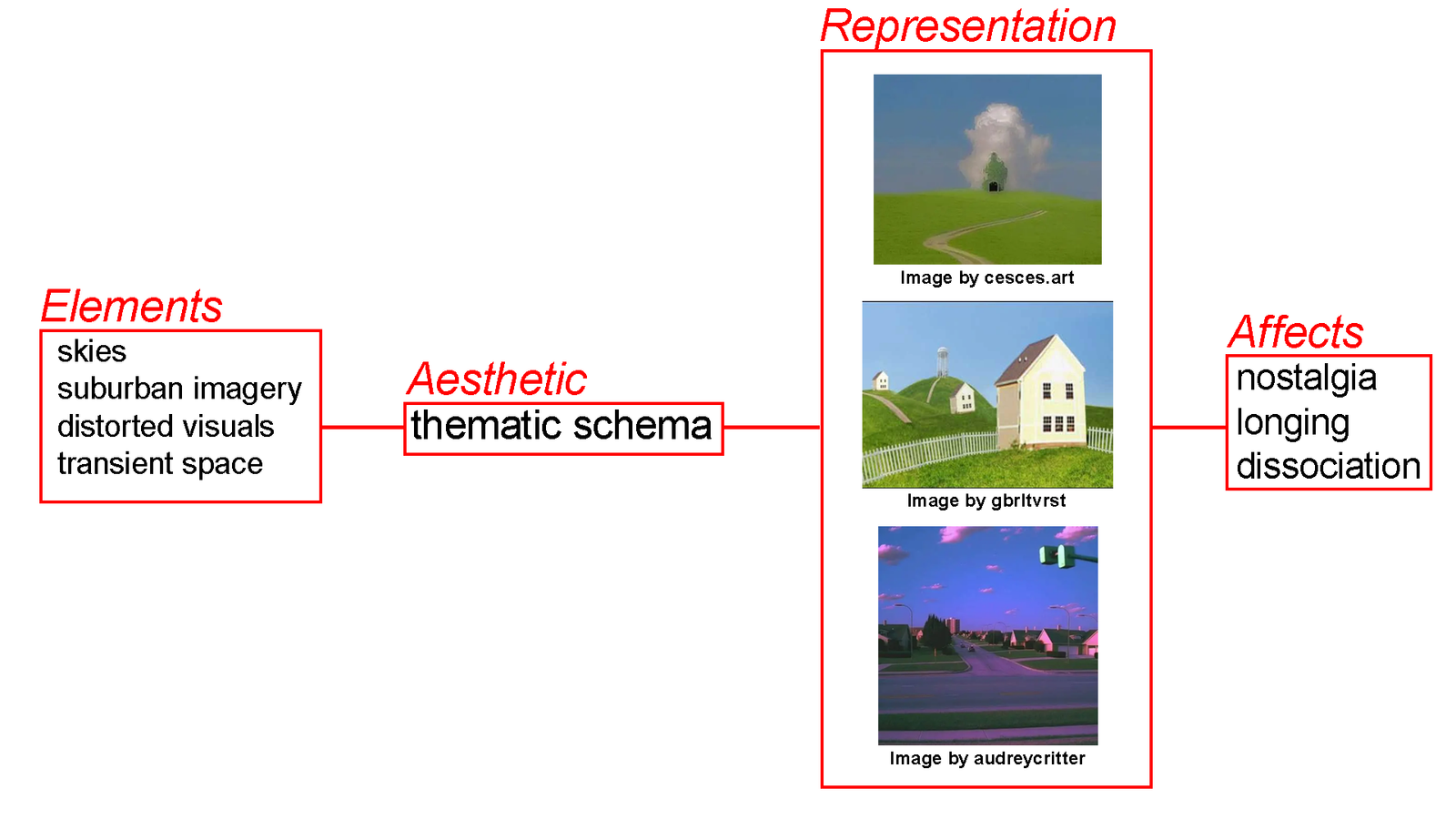
For the sake of this framework and in its most abstracted sense of the word, the term aesthetics refers to a complex of elements that are oriented by implicit rules, which give form to representations. When these representations are engaged with, they elicit certain affects that become associated with the aesthetic’s tag, keyword, or label.
It is unclear how these rules come about. They not only mutate as an aesthetic emerges or re-emerges into the cultural collective consciousness, but the cause of their emergence in the first place is unknown. At first, it may seem that there are novel pieces of internet art that when compared, share universal similarities that appear as a constellation of some kind of art movement. But then we’d have to ask, “what served as the inspiration for these works in the first place?” We can theorize that perhaps, there are certain pre-conscious affects residing within a so-called “collective unconscious,” from which vague impressions throughout the culture call them forth to be concretized and represented.
Regardless, these clear similarities across individual pieces, and their sheer quantity, create a demand to be crystallized, or recorded in some way through the use of a label. This so often is the case with those aesthetics taking advantage of the suffix, “-core.” Therefore, when we use the term “aesthetic,” as it is colloquially used on the internet, what we are actually referring to is that abstract constellation, those universal similarities across particular representations, that we may associate to a label. Once a label has become its own colloquial term to refer to its respective associated representations and their affects, we can say that it has become a part of our cultural consciousness. Projects such as the Aesthetics Wiki, are dedicated to recording and keeping track of those labels that are cast into the cultural collective awareness.
When we give a name, tag or label to an aesthetic, we are using language as a container to describe the constellation of its respective set of elements, the rules that orient them, the output or representations from those rules, and the intended affects one has as a result of engaging with those representations.
To define aesthetic more succinctly: an “Aesthetic,” is an abstract schematic that organizes elements to produce representations for an intended affect.
Affect
The term “affect” here, may be a bit loaded with ambiguity. What I am referring to is the initial impression upon the perceiver, on a level that is usually pre-conscious and pre-articulation. Part of the reason aesthetics become popular is because of the very novel and potent affects they are capable of producing. A common affect broadly used by aesthetics is nostalgia. However, the kinds of elements, or representational motifs present throughout work associated with a particular aesthetic label, may impose this affect of nostalgia differently. Some aesthetics create the affect of nostalgia by representing dream-like visuals and collages of plastic toys from the early 2000s. Others may do so by embracing a lo-fi sound into a piece of music. Regardless of medium, the affects produced by an aesthetic representation, or image (either visual or non-visual image), serves as a main mechanism for how an aesthetic becomes socially contagious. To the degree that an aesthetic’s representations are capable of producing an affect of high valence is to some extent, the same degree by which it becomes a potent cultural pathogen.
What is most important to understand when it comes to the significance of affect, is the almost unspeakable experience one has when engaging with a resonant aesthetic and its corresponding representations. Precisely why internet aesthetics have become such a trend within online culture, is because they give words to affects that are so deeply rooted in our cultural psyche, that they intrude us with a sense of wonder as we try to bring them back into our conscious awareness.
There is something that comes alive in us when we finally have a word to communicate these strange impressions. The more potent the image is within the culture, the more a label becomes loaded with an affectual valence. A whole revival might take shape, as can be seen with many artists who have revisited the so-called “Frutiger Aero” aesthetic. Until eventually all the pre-conscious affects have been fully realized, the aesthetic becomes fully exhausted, and the movement dies out again, forced to rescind back into the collective unconscious.
AESTHETIC SPACE
Physical Space
Physical space is that which exists without any simulating apparatus. It is what we in the most basic sense, consider to be the “real world.” One’s body, without any necessary simulated extensions, occupies this space. Physical space is independent of virtual space.
Virtual Space
Virtual space is space that is simulated digitally. Although technically narratives in books could be considered “virtual space,” it will be used here to refer to digital spaces, especially those that connect individuals via the internet. Social media, Pinterest feeds, search engines, desktops, video games, virtual reality spaces, and so on, are examples of virtual space. Although we can think of virtual space as separate from physical space, we can only operate it through the use of our physical bodies in physical space (you must use your hands to operate a smartphone, you must use your eyes to watch a television screen, you must use your ears to hear music through speakers). Likewise, virtual space relies upon the properties of physical space in order to emerge (the existence of software is only possible with the existence of hardware). Therefore, virtual space is dependent on physical space, and is nested inside of physical space.
The Relationship Between Physical Space and Virtual Space
Before the internet, the relevancy of virtual space did not apply so broadly as it does now. Prior to computers, virtual space did not exist, at least not within the constraints we are operating within. Therefore before the internet, the material and production of art existed solely within the realm of physical space. During the modern period, reproduction of media became much more accessible through the technological developments of that time. However, it was still physical copies that were being reproduced. With that said, now anyone can view high-quality scans of art pieces from those time periods on the internet in virtual space. For this reason, the aesthetics of modern art are produced as a movement within physical space, and not virtual space, but can still be consumed within virtual space.
Art movements that begin on the internet however, have an inverse relationship. When we speak of aesthetics such as “Xpiritualism,” we’re referring to an art movement that emerged due to, in response of, and within the realm of virtual space. However, I can take the same arrangements of elements that comprise the aesthetic, represent them in physical space, and create a physical rendition of the Xpiritualism aesthetic. Therefore, the aesthetics of the internet are produced as a movement within virtual space, and not physical space, but can still be created and consumed via physical space.
What is important is that we make the discrimination between the mode of consumption, and the origins of the aesthetic schema. Regardless of the mode of consumption (viewing a physical copy or viewing a virtual copy on a computer screen), a post-impressionist painting remains a post-impressionist painting. However, if I were to declare that the aesthetic schematic that we may associate with the term “post-impressionist” originated online, that would clearly be a false statement.
When we speak about the “aesthetics of modern art in the early 20th century” or the “aesthetics of early 2000s webpages,” regardless of how obvious an observation it may be, it is crucial that we recognize that we are talking about two fundamentally different aesthetic subjects. For the former, we are speaking of something that emerged within physical space, and furthermore, before the introduction of a virtual space. As for the latter, we are speaking of something that emerged from the unique properties of virtual space.
Since the introduction of the virtual space as a condition from which aesthetics emerge, the subject of aesthetics as a whole has been forever changed. Going forward, when we speak of aesthetics, we must now always consider the relationship between physical space and virtual space.
CATEGORIES OF AESTHETICS
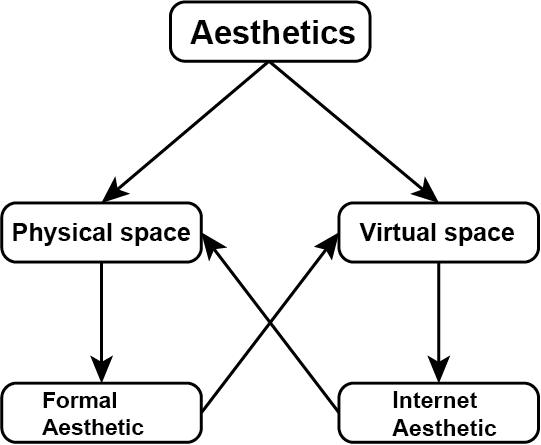
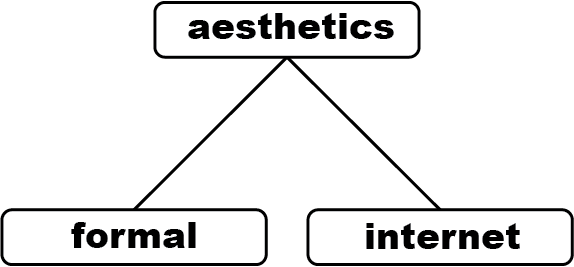
Now that we have differentiated the forms of space, we now have a source to derive our axioms, and can begin to create proper categories for the kinds of aesthetics that exist. Clearly, there are two ready-made. Aesthetics that originate in or emerge from virtual space, and Aesthetics that originate in or emerge from physical space.
Aesthetics that originate in virtual space may be called “internet aesthetics,” as this is the term most are already familiar with. Aesthetics that originate in physical space may be called “formal aesthetics,” mostly just to differentiate them from internet aesthetics.
Subcategories
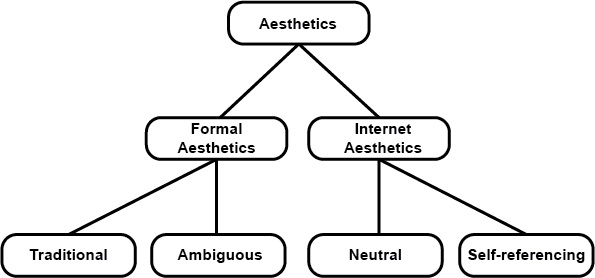
Now that we have two basic categories of aesthetics, we can begin to create subcategories that may be less obvious. Formal Aesthetics have already been categorized over the course of history, however Internet Aesthetics are a relatively new phenomena. Therefore, it is practical that we may attempt to categorise them. Within the category of internet aesthetics, there exists two distinct subcategories, which emerge according to the following logic:
- The aesthetic originates in virtual space
- The aesthetic uses elements that references virtual space, or the internet, to produce representations that further produce their intended affect.
For something to be classified as an “internet aesthetic,” premise number one must always be true. For if it were false, the aesthetic would NOT have emerged from virtual space, and therefore could have only emerged within physical space. Remember that aesthetics which originate in physical space are “formal aesthetics,” not internet aesthetics.
It is therefore premise number two that generates differentiating subcategories under the overarching class that is “internet aesthetics.” The elements that are organized by the aesthetic’s rules either reference virtual space, or do not reference virtual space. This provides us two subcategories of internet aesthetics:
Neutral Internet Aesthetics:
- Originate on the internet
- Elements DO NOT reference the internet
Self-Referencing Internet Aesthetics:
- Originate on the internet
- Elements DO reference the internet
However, following this binary logic, which only has two premises, we can generate two subcategories of formal aesthetics:
- DOES NOT originate on the internet AND DOES NOT reference the internet
- DOES NOT originate on the internet AND DOES reference the internet
The first condition does not meet the criteria of an internet aesthetic because it is not sourced from virtual space, and it's elements do not reference the internet. These aesthetics would fall into the category of traditional aesthetics. Historical art, fashion, music, or any other movement, would fall into this category, so long as its origins and elements bear no dependence on virtual space.
The second condition however, is much more interesting because it appears to be in a contradictory state. It is an aesthetic that is not sourced from virtual space, yet is clearly aware of virtual space as the elements of the aesthetic are sourced from or reference virtual space. One may say that this should eliminate the category, or that it should be considered a self-referencing internet aesthetic. However within this framework, it is only possible for an aesthetic to be an “internet aesthetic,” if it originates via the internet and virtual space.
Therefore, I consider this category ambiguous aesthetics, because it superimposes the categories of internet aesthetics and traditional aesthetics. Ambiguous aesthetics are aware of, and may even reference or use elements of virtual space, but exist in mediums of physical space, as the original work exists independent of virtual space.
Neutral Internet Aesthetics
Neutral internet aesthetics are those aesthetics that fit the criteria of originating online, but the rules that orient the elements and the elements themselves, do not produce images that refer to the internet. They exist as internet aesthetics, but their elements exist independently of the internet.
When we consider popular internet aesthetics such as “Cottagecore,” this may be a bit confusing. Cottagecore is an internet aesthetic that aestheticizes the western agricultural life. Its elements often include plant imagery, flowers, white flowy dresses, home baked goods, cottages, and so on. These elements are organized in ways that produce affects associated with nostalgia, harmony, and tenderness.
What makes Cottagecore an internet aesthetic however, is the way in which this aesthetic formed, and how it was used. Cottagecore was an aesthetic that began on platforms such as Tumblr, Instagram, and TikTok, and exploded in popularity following the lockdowns of the Covid-19 pandemic. Even though the imagery of this aesthetic has existed for vastly longer than the internet, the communities of the internet have collectively created a term for images that produce the desired affect, and collectively discriminate between which images do and do not fall under the aesthetic term. Furthermore, the representations of cottagecore are often intended to be consumed via virtual space.
Self-Referencing Internet Aesthetics
Self-referencing internet aesthetics are those aesthetics that fit the criteria of originating online, while the rules that orient the elements and the elements themselves, produce images that refer to the internet itself. They exist as internet aesthetics, and yet their elements are sourced from the internet.
Oftentimes, these aesthetics contain references to early internet culture such as internet memes, old web design, old music that was popular online, and so on.
Self-referencing internet aesthetics are interesting because they are often reflective of the ongoing collective sentiment or dialogue about internet culture. For example, there are many aesthetics, such as “Internet Awesomesauce” whose visual elements directly reference memes and elements present in early 2000s and 2010s internet culture. During this time, these elements were implicitly bound to a general aesthetic or thematic sense. When communities that engage with these elements age, they begin to collectively reflect on the past elements of culture. While reviewing the past, the implicit-ness of the elements get explicated by the creation of a label that represents it. The demand for such a label arises from a collective interest in reviewing these past elements of subcultures.
Further, neutral aesthetics may become self-referencing aesthetics. Initially, the aesthetics of forum cultures in the early 2000s clearly originated on the internet and their webpages produced novel design elements that existed in virtual space. Yet, their layouts existed for the pragmatic purposes of their site function. Yet in today’s internet, many aesthetics have reflexively examined those elements and incorporated them in art to provoke nostalgic affects relating to these elements. Therefore, the aesthetic has gained the quality of self-reference. The eye of the aesthetic exists in a condition of re-interpretation. This is evident in the evolution of memes such as the trollface (which has began to appear as a sincere symbol in internet art), and in aesthetics such as Frutiger Aero.
Nowadays, when individuals create a visual whose elements are compositionally adjacent to the “Internet Awesomesauce” aesthetic or any other self-referencing aesthetic, it would no longer be recognized as an authentic product of subculture. Rather, because the collective consciousness of the internet has reviewed, reflected, and explicated these elements, the visual would be interpreted as a post-ironic gesture with the intent of reflecting on the naivety of these past elements. The implicit aesthetic is no longer that which produces the collection of elements, rather the collection of elements perpetuates the explication of the aesthetic after the fact of its collective recognition.
The subcultures that existed previously are reviewed within the context of the new conditions. To remain sincerely proximal, while also acknowledging its inherent immaturity, these subcultures themselves become the subject matter of the current subculture. When virtual agents consume products of self-referencing material, they are not directly participating in the root subculture, rather they are referencing their participation in the root subculture.
Traditional Formal Aesthetics
Traditional aesthetics are those aesthetics that do not originate on the internet, and do not include any elements that refer to the internet. They do not emerge from virtual space, may come before the existence of virtual space, and the images that emerge from the aesthetic are not necessarily intended for consumption within virtual space.
This category would mostly contain aesthetics of historical art movements, or any image that takes form within physical space that does not reference the internet. For example, modern art can be considered a traditional aesthetic. It has its own aesthetic values, its own elements those values organize, and its own intended affects. However the medium through which these images are reified exist and are mostly intended to be consumed within physical space.
Ambiguous Aesthetics
Ambiguous aesthetics are those aesthetics which do not originate on the internet, but include elements that refer to the internet. They do not emerge from virtual space, however the images that emerge from the aesthetic are clearly aware of the internet.
A proper example of an aesthetic that falls into this category is the post-internet art movement. Post-internet art still references the internet, although indirectly, yet typically exists in mediums outside of the internet.
Hypothetically, as the internet becomes increasingly intertwined within physical life, traditional aesthetics will gradually bleed more into ambiguous aesthetics. A more radical view may have it that there can no longer exist any “new” traditional aesthetics, for hardly a soul on the planet is not at least partly aware of the internet’s existence. Therefore, all representations originating within physical space now contain some form of perspective informed by the internet. All “new” aesthetics originating in physical space are ambiguous aesthetics.
SUPER-AESTHETICS
The categories outlined above, are top-down, totalizing categories. They serve to label individual aesthetics so as to store what kinds of properties they may have, and are basic fields we may begin associating properties of aesthetics to. However, there are naturally limits to such a rigid approach, as along the development of this ontology, one of the core assumptions that are made may be negated for this reason or another. Or we may find that our criteria is not rigorous enough, and that we need to add more premises to properly deduct categories. In either case, the whole thing needs restructuring.
Furthermore, these top-down categories are based on a logic of space. They define the position of an aesthetic based on its spatial origins. None of our axioms depend on a social context by which they exist, outside of their respective spatial relations. Thus, any other properties we may prescribe to an aesthetic must necessarily be derived a posteriori. We can only arrive at a detailed level of social analysis through various methods of induction.
Therefore, it becomes prudent to include a bottom-up method for inducing categories. We can do this by using a network structure as opposed to a tree structure. This will be my attempt at providing a method for inducing the essences of aesthetics, or the super-aesthetics.
Because aesthetics are recorded on the internet in databases such as the Aesthetics Wiki, an inductive approach is possible. By taking some form of measurement for each aesthetic, and then associating the aesthetic to others by some criteria of proximity, we can create a network graph of aesthetics. We can then use a clustering method to achieve an approximate number of overarching aesthetic themes. This would serve as a layer of abstraction above individual aesthetics, where each cluster exists as an abstract representation, an essence of qualities among labeled and recorded individual aesthetics. This is what I’ll be calling the “super-aesthetics.” I have already attempted to discern the super-aesthetics in my text, An Analysis of Internet Aesthetics: A Framework for Aesthetic Elements Within Digital Subculture.
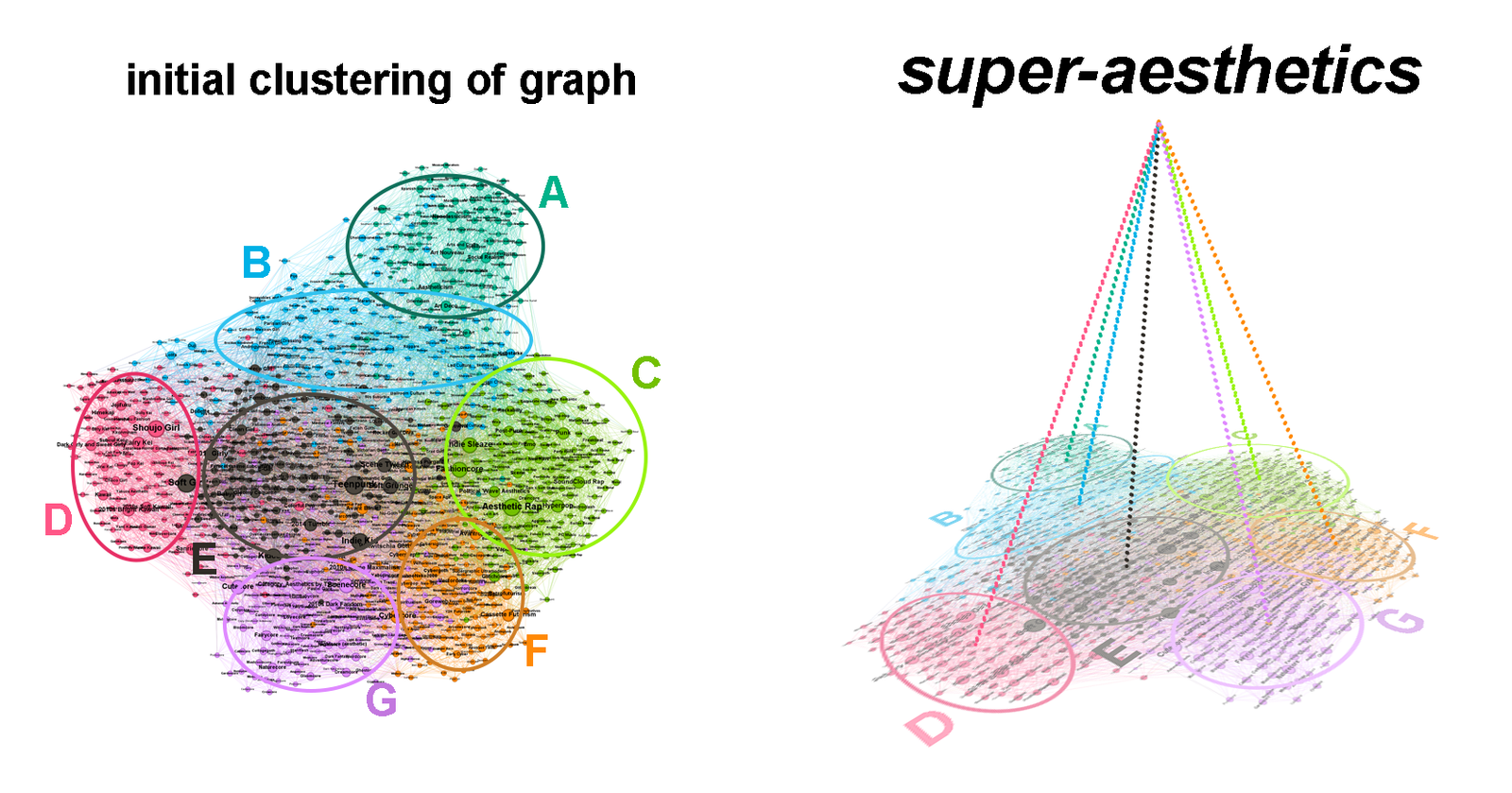
Further, and although I did not attempt this in my initial trial, this method also allows for an entire gradient to be made between the bottom and the up, or in other words, a network graph can be used as a base layer by which we can induce a top-level generalization, and then further iterate upon it to fill out categories in-between. A hierarchical structure of universality between aesthetics would then emerge. If you were to create an initial graph of all aesthetics and then cluster them according to some criteria of similarity, then you could isolate each cluster as its own network, and re-cluster all the way back down. Each level would provide you higher resolution categories for the aesthetics.
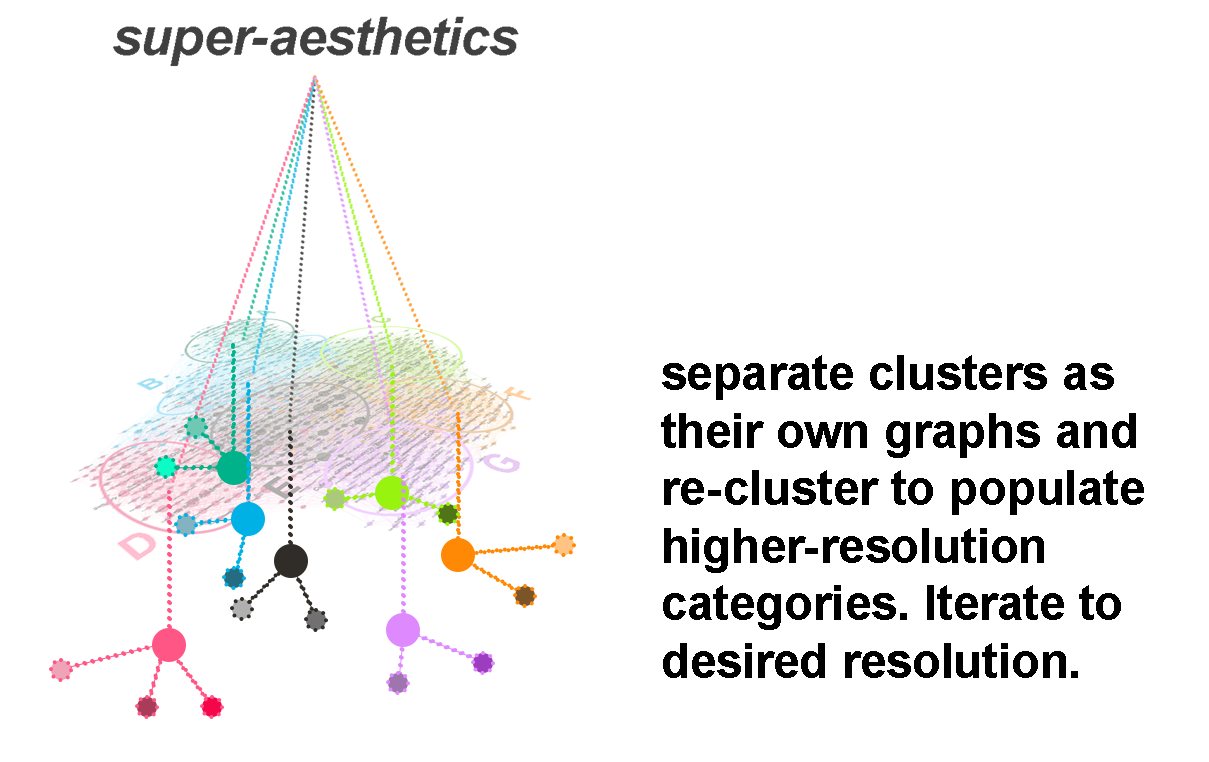
In my attempt, the method I used was linguistic, however in theory any method of association can be used depending on the subject of inquiry. I took text data from the Aesthetics Wiki, used word embeddings to obtain each text’s position in vector space, and then calculated a cosine similarity between each aesthetic. This generated a graph. From there I used a modularity statistic within Gephi to cluster. There were 8 distinct super aesthetics:
- General Feminine Aesthetics
- Futurism and Digital Aesthetics
- Fandom Aesthetics and “Cores”
- American Modernity and Goth
- Avant-Garde
- Eastern Aesthetics and Moe
- Music
- Fashion
It is important to note that this was a very rough attempt at discovering what I’m now referring to as the “super-aesthetics.” This is because in reality, the modes of measurement and the dataset available was incredibly narrow. And because this is a bottom-up method, we could only ever approximate the super-aesthetics. It is always going to depend on which methods are used to generate data based on similarities, and what data was examined. Although I used a linguistic method, another approach may use image-detection models and a large data set of images to discern visual similarities, instead of semantic similarity. So then, a multi-method approach is likely required to obtain an accurate and empirical approximation of the super-aesthetics.
The reason inducing super-aesthetics is a useful task, is because it is an empirical approach to deriving a cultural analysis of aesthetics. For instance, there are many highly associated aesthetics that when viewed from a higher-level of analysis, clearly indicate an overarching ideological association to feminism. These fall into the super-aesthetic class of “General Feminine Aesthetics.” Aesthetics are memetic. They contain within them implicit cultural ideas and information and spread in the same basic ways that memes and online slang do. By extracting this information, we gain insight into the cultural significance of aesthetics.
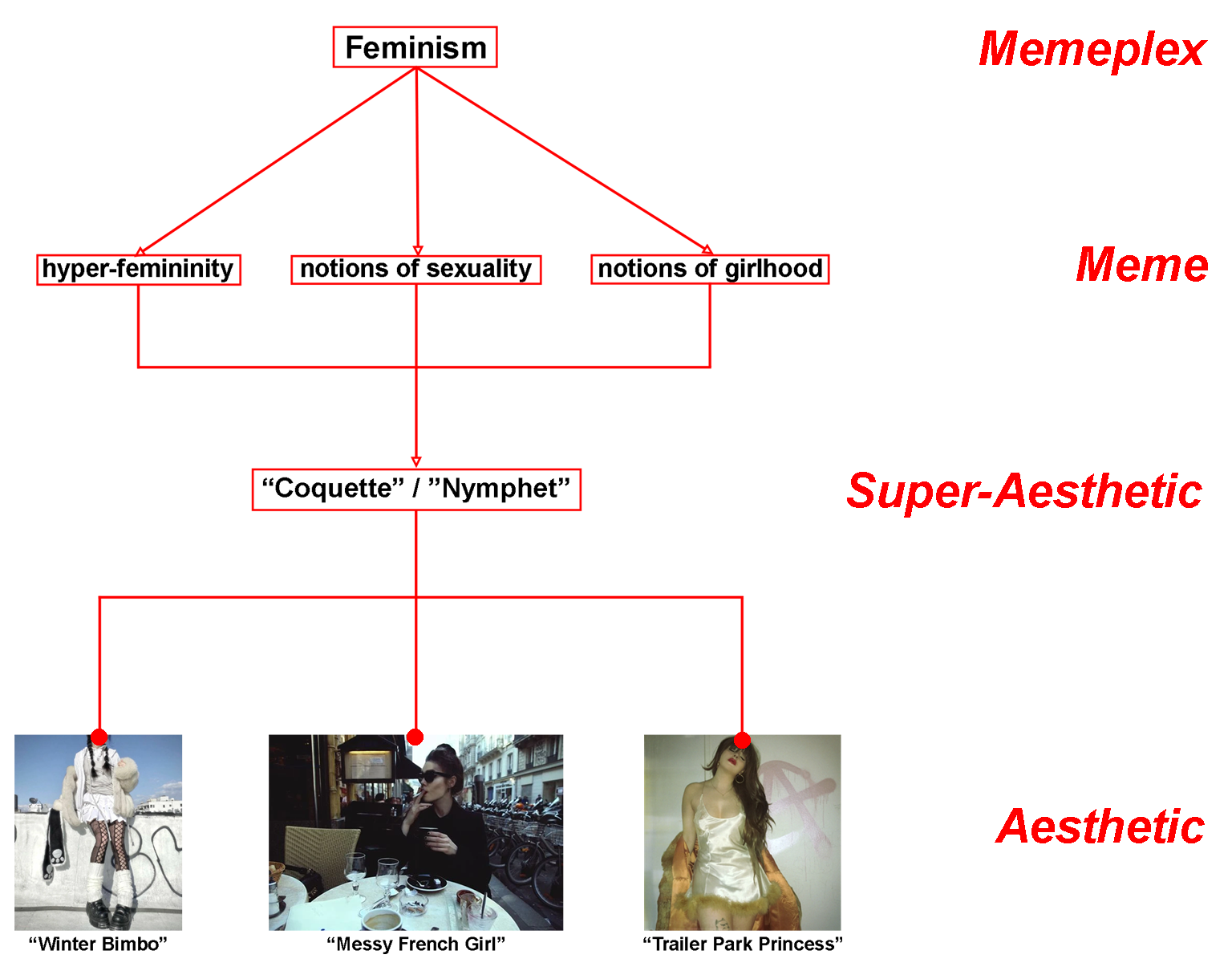
What memes are to memeplexes, is essentially what aesthetics are to super-aesthetics. A representation of an aesthetic is coded with some kind of cultural information. When viewing the breadth of representations that are assigned to an aesthetic label, one may gain an intuitive sense of what that label culturally represents. Iterating over this accross the breadth of aesthetics labels, our level of analysis is scaled until discernable categories emerge.