| Class 0 | Class 1 | Class 2 | Class 3 | Class 4 | Class 5 | Class 6 | Class 7 |
|---|---|---|---|---|---|---|---|
| "fashion" | "design" | "visual" | "style" | "art" | "fashion" | "genre" | "fashion" |
| "style" | "visual" | "style" | "fashion" | "artist" | "style" | "music" | "subculture" |
| "girl" | "style" | "fashion" | "goth" | "artistic" | "japanese" | "subculture" | "style" |
| "trend" | "color" | "theme" | "gothic" | "paint" | "color" | "style" | "wear" |
| "visual" | "fashion" | "genre" | "genre" | "style" | "outfit" | "punk" | "culture" |
| "popular" | "technology" | "color" | "subculture" | "design" | "subculture" | "band" | "dress" |
| "subculture" | "futuristic" | "imagery" | "clothing" | "depict" | "kawaii" | "artist" | "clothing" |
| "feminine" | "cyberpunk" | "motif" | "culture" | "painter" | "japan" | "fashion" | "youth" |
| "color" | "graphic" | "art" | "modern" | "sculpture" | "culture" | "mainstream" | "skirt" |
| "clothing" | "motif" | "palette" | "design" | "movement" | "character" | "rock" | "cultural" |
| "makeup" | "digital" | "tumblr" | "motif" | "painting" | "wear" | "visual" | "garment" |
| "culture" | "palette" | "artist" | "dress" | "decorative" | "anime" | "musical" | "genre" |
| "woman" | "genre" | "dark" | "visual" | "modernism" | "dress" | "rap" | "traditional" |
| "tumblr" | "art" | "romanticize" | "theme" | "century" | "kei" | "dance" | "brand" |
| "lifestyle" | "trend" | "horror" | "traditional" | "fashion" | "skirt" | "rhythm" | "outfit" |


An Analysis of Internet Aesthetics: A Framework for Aesthetic Elements Within Digital Subculture
Click here to view mobile graph
Click here to view in fullscreen
Click here to download project data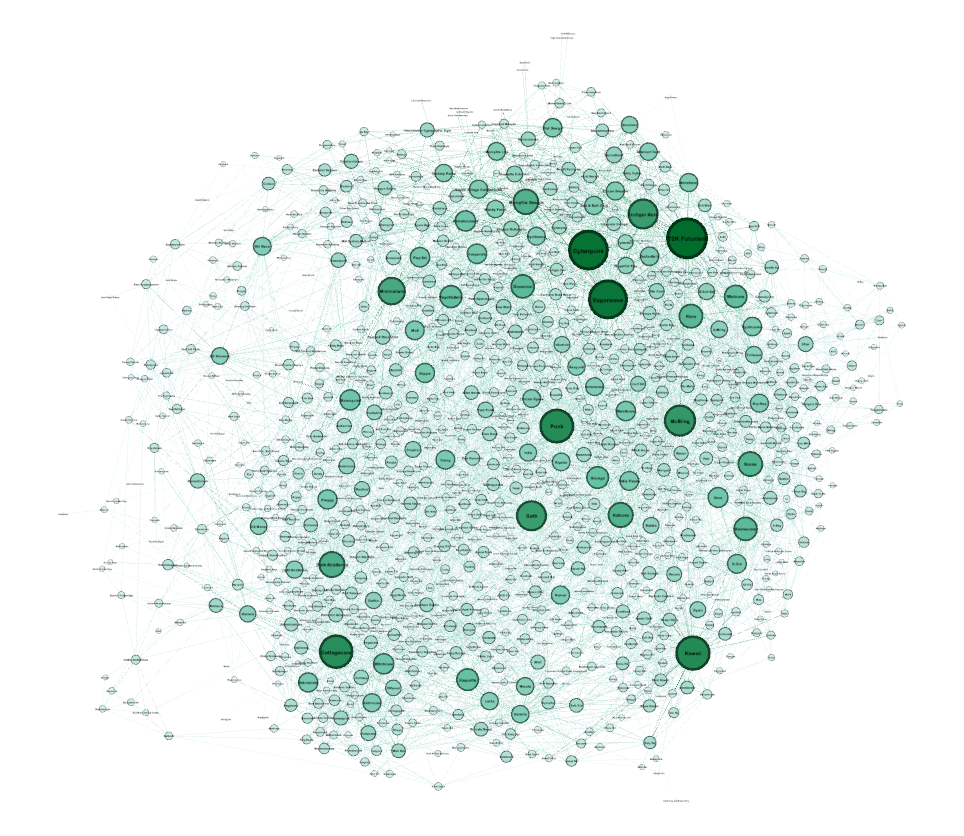
Click here to view in fullscreen
Click here to download project data
Introduction
The goal of this project is to investigate a relatively novel phenomena of culture, and more specifically internet culture, known as “internet aesthetics.” Internet aesthetics can be described as visual styles, subcultures, or themes that typically emerge through internet communication platforms, such as social media or online message boards.
The “Aesthetics Wiki”, is an online wiki that categorizes and lists the many different aesthetics that have risen out of general culture, as well as internet culture. This wiki provided the source material required for this project.
This text is a casual discussion of the methods used and the insights that I have developed through trying to understand the phenomena of internet aesthetics and more broadly, internet culture. Here I will cover the method used to uncover such insights, as well as my own commentary on the matter. If this investigation has any influence at all, there are a few outcomes I deem desirable, ordered by their importance to me:
- Discussion about internet subculture and aesthetics are in some way furthered.
- Artists and analysts may find utility in a visualization of connectivity between aesthetics.
- The method used may be replicated for further inquiry and iteration.
- The graph generated is fun to look at.
I will first lay out my definitions of internet aesthetics. I will then detail the method used to generate the graph, and display the results numerically. Then, I will discuss the results with my own interpretation. The “Discussion” section of this article is where I will speculate about the meaning of the results within the broader context of internet culture.
What is an Internet Aesthetic?
Internet aesthetics in recent years have become a subject of interest for both those that enjoy them, and those who seek to study their importance in internet culture. Since the internet has become a tool that highly connects people to one another within virtual space, communities and subcultures that otherwise could not exist, have thrived. What emerges from these communities is often a unique set of experiences that are organized by subculture, and express themselves through visuals, themes, and language. In essence, this is what is known as an “internet aesthetic."
It is prudent that we make the distinction between what we may regard as “aesthetics”, and “internet aesthetics.” This distinction is necessary, as it adds an important layer to the discussion: the space by which these aesthetics emerge. When we speak about the “aesthetics of modern art” or the “aesthetics of early 2000s webpages,” it is crucial that we recognize that we are talking about two fundamentally different aesthetic subjects. For the former, we are speaking of something that emerged within physical space, and furthermore, before the introduction of a virtual space. As for the latter, we are speaking of something that emerged from the unique properties of virtual space.
Since the introduction of the virtual space as a condition from which aesthetics emerge, the subject of aesthetics as a whole has been forever changed. Going forward, when we speak of aesthetics, we must now always consider the complex relationship between physical space and virtual space.
Before we can understand the history of internet aesthetics, we must first discriminate between the time before and after the term “internet aesthetic” was collectively acknowledged and its meaning collectively agreed upon. This will help us build a more precise definition of what an “internet aesthetic” is.
How did Internet Aeshetics Emerge?
There is not an exact moment from which the internet as a collective began to understand and canonize “internet aesthetics.” Rather, it came about through the development of communication of online communities since the advent of the webpage and the cultural progression of social media.
First, there is the pre-conscious internet aesthetic. These are elements of virtual subcultures that have existed as a result of interactions within communities of virtual space. This was a time when communities were generating elements that would later be described as a collectively recognized “internet aesthetic” but pre-date the term.
For instance, although the visual elements of the “Frutiger Aero” aesthetic were developed and produced somewhere between 2005-2013, the term “Frutiger Aero” was not coined until 2017. Around 2022 the aesthetic, now with a name to represent its collection of visual elements (and therefore a searchable keyword), made a massive comeback and has sparked various subgenres of aesthetics.
There was clearly a time when the collective of the internet had been producing collections of elements from its respective subcultures, and a time afterward when the collective consciousness of the internet began to give names and labels to these collections of elements. Once these collections of elements have names to represent them, they become keywords and tags on social media platforms. This labeling permits the collection of elements to be accessed via algorithms and searchable tags, which increases their viability as contagious agents. Once a collection of elements and its respective label is proven to be memetically viable, it enters the online canon as an “internet aesthetic.”
In theory, the beginning of this collective tendency to organize elements of subcultures into labels begins with the blog cultures of Tumblr. Tumblr is a blog-based social media platform that was created in 2007, and the very structure of the user-experience bleeds with personalization. The search function of Tumblr uses a tagging system. When you search for a keyword on Tumblr, you are presented with posts that the user has tagged using that keyword.
Because of the thematic potential of a blog’s personalization features, and because of this tagging system, keywords that were implicitly agreed upon by the respective collective that used a given theme, likely and necessarily emerged so that these users could reblog and share content that contained similar thematic elements. This becomes especially apparent when understanding the use of the suffix “-core.”
The “-core” suffix is used to indicate an element that is central or otherwise fundamental to its object or subject. Before it was used as internet slang, it was mostly used to describe various music genres, hence “hardcore.” However, as user identity has become an integral part of internet subcultures, the term has been used as a universal signifier to denote the aesthetic of something. Right now, you can go to Tumblr and search any term while adding the suffix “-core,” and find aesthetic content pertaining to that term.
For instance, if my blog is centered around the color pink, then to find other users that have similar themes, and to find content that I can share for my own blog, I can search the term “pinkcore.” When I do this, various aesthetic imagery is shown, but the universal element among all of them is the color pink.
As social media began to crystallize as central hubs within the network of the internet, profile themes were used across different platforms. Aesthetics were not bound to Tumblr blogs, but also to Instagram accounts (2010), Pinterest boards (2012), and even Youtube channels. All of these platforms have their own tagging systems used for search features and to identify user interest. This is likely when the notion of the “internet aesthetic,” entered the internet cultural lexicon.
By far however, the popularization and propagation of internet aesthetics can be attributed to the rise of TikTok and the Covid-19 pandemic. Tiktok has all of the features that have already been mentioned: a tagging system and user personalization. However, Tiktok marks the rise of short-form content. The revolutionary ways in which TikTok’s content system has gripped user attention, has accelerated the tendency of trends. Combine this with the fact that the world was spending much more time online during the pandemic, it becomes clear how discourse about internet aesthetics accelerated. Much like how a virus spreads much faster in an urban city, so does the collection of elements represented by tags spread on a highly populated social media app.
We can indicate a general timeline of internet aesthetics:
"Pre-conscious Era"
- Content was not produced for a tag, name or label, rather for its own purposes
- Collections of elements were produced by the natural interactions between users in virtual space
- The term “internet aesthetic” had not yet been collectively recognized
- Designs did not necessarily self-reference the internet
- Vaguely exists between 1995-2007, as webpages and message boards developed
"Social Media Era"
- Content was used as a form of user expression and identity
- Tagging systems allowed for queries of elements
- Social media crystalizes as central hubs of network. Virtual communities, common or fringe, begin to center around single platforms
- Collections of elements began to receive names and tags
- “-core” suffix used to denote aesthetic specificity
- Vaguely exists between 2007-2017
Current Era
- Inherits many qualities of social media era
- Accelerated memetic contagion of aesthetics
- “Internet Aesthetic” collectively recognized
- Certain aesthetics begin to self-reference the internet
- Mass labeling of the natural collection of elements that emerged from the pre-conscious era ("Meme Maximalism", "Xpiritualism", "Internet Awesomesauce", etc.)
- Vaguely exists between 2017-present
What Makes an Aesthetic an "Internet Aesthetic?"
An internet aesthetic, is a collection of visual elements that have been arranged mostly or exclusively within virtual space. To some extent this may be confusing when considering aesthetics such as “Cottagecore,” where seemingly the visual elements of the aesthetic have nothing to do with the internet.
However, the reason these aesthetics are still considered “internet aesthetics,” is due to their emergence through virtual space:
- The collection of elements were organized by users within virtual space, who then use those elements to theme their accounts across various social media platforms.
- The aesthetic’s label, tag, or name that represents the collection of elements were created through the organizing features of virtual space (algorithms, tagging systems, etc.).
- The community of online identities that form a collective around the represented collection of elements is large, so as to legitimize the memetic value of the aesthetic within the broader culture.
Subcategories of Internet Aesthetic
Within the totalizing category of internet aesthetics, there exists two distinct subcategories.
General internet aesthetics
- Originate on the internet
- Content of the aesthetic IS NOT about the internet
Self-referencing internet aesthetics:
- Originate on the internet
- Content of the aesthetic IS about the internet
Self-referencing internet aesthetics are interesting because they are often reflective of the ongoing collective sentiment or dialogue about internet culture. For example, there are many aesthetics, such as “Internet Awesomesauce” whose visual elements directly reference memes and elements present in early 2000s and 2010s internet culture. During this time, these elements were implicitly bound to a general aesthetic or thematic sense, however in retrospective review of culture this implicitness has been explicated by the creation of a label that represents it. The demand for such a label arises from a collective interest in reviewing these past elements of subcultures, and therefore to some extent can be credited to nostalgia.
Nowadays, when individuals create a visual whose elements are compositionally adjacent to the “Internet Awesomesauce” aesthetic or any other self-referencing aesthetic, it would no longer be recognized as an authentic product of subculture. Rather, because the collective consciousness of the internet has reviewed, reflected, and explicated these elements, the visual would be interpreted as a post-ironic gesture with the intent of reflecting on the naivety of these past elements. The implicit aesthetic is no longer the thing that produces the collection of elements, rather the collection of elements perpetuates the explication of the aesthetic.
This is part of what I refer to as “meta-subculture.” The subcultures that existed previously are reviewed within the context of the new conditions. To remain sincerely proximal, while also acknowledging its inherent immaturity, these subcultures themselves become the subject matter of the current subculture. When people consume products of meta-subculture, they are not directly participating in the root subculture, rather they are referencing their participation in the root subculture.
Method
The general idea for this project was to find a way to reduce all of the aesthetics listed on the Aesthetics Wiki into abstract categories. Hypothetically once this is achieved, an idea of the thematic and ideological influences underpinning aesthetics on the internet could be vaguely conceptualized.
For this project, two graphs were generated. The first, was essentially a sitemap of the Aesthetics Wiki. Each aesthetic on the wiki has its own webpage that includes the name of the aesthetic, text about the aesthetic, pictures of the aesthetic, and outgoing links to aesthetics that are deemed similar to that aesthetic.
The First Graph
The first graph was generated by using a python script that used the MediaWiki API to get the names of each aesthetic on the Aesthetics Wiki, and then the outgoing links listed under “related aesthetics” of each page. This script then wrote the names of each aesthetic to a CSV file into the first column. Then, the script wrote the name of each aesthetic and its outgoing related aesthetic into a separate CSV file, where the first column represents a node and the second represents the related aesthetic that the node points to. The first CSV file was used to draw each node, and the second was used to draw each edge between the nodes.
However, this method posed a problem with the naming convention of aesthetics on the Aesthetics Wiki. Some aesthetics go by many different names, and often are listed differently under the “related aesthetics” section of a given webpage. To solve this, the data was manually cleaned to unify aesthetics that had many names, so that they could all be represented by one node.
Once the CSV files were cleaned, they were loaded into Gephi, a network analysis software, and the following visualization was produced:
The Main Graph
The main purpose of this project was to inquire into how internet aesthetics are related, and how their elements can be grouped. The generation of the first graph does not fulfill this for a few reasons. The first being that what determines how an aesthetic gets listed under the “related aesthetics” of an aesthetic’s webpage, is not entirely clear. There is a whole community that has built the infrastructure of the wiki. Although that community is likely very informed and the relations between aesthetics are likely accurate, there is not a quantitative reason for why aesthetics may be related that is overtly disclosed. In the effort to remain empirical, another approach was required.
Another issue is that this project seeks insight through comparing meanings between aesthetics. Because this project takes a quantitative approach, it necessarily finds insight via induction. The general idea of the approach that was used was to find a natural method of relating aesthetics, and from there, abstracting to find stable patterns that emerge from the data. The kind of information that was eventually chosen was linguistic. Because words can be used as containers for meaning, they can represent both the visual and thematic elements of a given aesthetic. For example, if an aesthetic frequently uses the color blue, that can be represented by linguistic information instead of visual information, such as the text “blue.” Linguistic information takes precedence, because it can represent all forms of information extractable from an aesthetic.
Natural Language Processing (NLP) methods that prioritize semantics were used. A python script was made that uses the MediaWiki API to get the articles of every aesthetic on the Aesthetics Wiki. These articles were then written to a TXT file with the name of the respective aesthetic.
A separate python script was used to embed the texts into vector space, and then compare them using cosine similarity. Cosine similarity outputs a value between 1 and 0. These values were used as weights for the edges between nodes. The same CSV file from the first graph was used to generate the nodes, and a python script wrote the new edges generated by this method to a new CSV file.
There is an obvious problem that emerges from this method. Because the text of each node is being compared to the text of every other node, the total amount of edges that would be drawn is n^2. Because there are 1,063 nodes, over 1,100,000 edges would be drawn. In order to have a reasonable amount of data that could be used, and to only visualize relevant connections, any edge with a cosine similarity < 0.35 was dropped from the data. The total amount of edges left was 12,011.
The CSV files were then imported into Gephi. Using Gephi, modularity was calculated to find distinct community clusters. Because aesthetics are mapped according to semantic similarities, the clusters should in theory provide overarching semantic categories that are distinct from one another. Modularity was run with the following parameters:
- Randomize: On
- Use edge weights: On
- Resolution: 1.0
Once the communities were detected in Gephi by running the modularity statistic, the articles of each aesthetic were grouped by their respective community, and then further analyzed. KeyBert was used to obtain relevant unigrams. The parameters were as follows:
- keyphrase_ngram_range=(1, 1)
- stop_words="english"
- top_n=50
Unigrams were then lemmatized, their total appearance in the text summed, and their semantic KeyBert score summed. Each cluster then had this data written to a JSON file.
Results
Modularity results were as follows:
- Modularity: 0.524
- Modularity with resolution: 0.524
- Number of Communities: 8
Quantity and proportion of nodes in communities:
- Community 0: n=136 (12.79%)
- Community 1: n=127 (11.95%)
- Community 2: n=186 (17.50%)
- Community 3: n=79 (7.43%)
- Community 4: n=107 (10.07%)
- Community 5: n=121 (11.38%)
- Community 6: n=159 (14.96%)
- Community 7: n=148 (13.92%)
The top 15 unigrams of each community (class) are as follows:
| Class 0 | Class 1 | Class 2 | Class 3 |
|---|---|---|---|
| "fashion" | "design" | "visual" | "style" |
| "style" | "visual" | "style" | "fashion" |
| "girl" | "style" | "fashion" | "goth" |
| "trend" | "color" | "theme" | "gothic" |
| "visual" | "fashion" | "genre" | "genre" |
| "popular" | "technology" | "color" | "subculture" |
| "subculture" | "futuristic" | "imagery" | "clothing" |
| "feminine" | "cyberpunk" | "motif" | "culture" |
| "color" | "graphic" | "art" | "modern" |
| "clothing" | "motif" | "palette" | "design" |
| "makeup" | "digital" | "tumblr" | "motif" |
| "culture" | "palette" | "artist" | "dress" |
| "woman" | "genre" | "dark" | "visual" |
| "tumblr" | "art" | "romanticize" | "theme" |
| "lifestyle" | "trend" | "horror" | "traditional" |
| Class 4 | Class 5 | Class 6 | Class 7 |
|---|---|---|---|
| "art" | "fashion" | "genre" | "fashion" |
| "artist" | "style" | "music" | "subculture" |
| "artistic" | "japanese" | "subculture" | "style" |
| "paint" | "color" | "style" | "wear" |
| "style" | "outfit" | "punk" | "culture" |
| "design" | "subculture" | "band" | "dress" |
| "depict" | "kawaii" | "artist" | "clothing" |
| "painter" | "japan" | "fashion" | "youth" |
| "sculpture" | "culture" | "mainstream" | "skirt" |
| "movement" | "character" | "rock" | "cultural" |
| "painting" | "wear" | "visual" | "garment" |
| "decorative" | "anime" | "musical" | "genre" |
| "modernism" | "dress" | "rap" | "traditional" |
| "century" | "kei" | "dance" | "brand" |
| "fashion" | "skirt" | "rhythm" | "outfit" |
Discussion
This method and its execution would benefit from much refinement. If I were to iterate on this method in the future, I would first dramatically increase the amount of text available for each aesthetic. Because the data is all coming from one source, the aesthetics wiki, it lessens the confidence that we may apply any insight gained from this method to internet aesthetics and the broader category of internet culture. Aesthetics that have not been thoroughly concretised within the culture often have very little text written about them as well. Second, I would run many trials of modularity, given the use of the "random" parameter in Gephi's modularity statistic. Lastly, I would be more rigorous with the lemmatizing process.
Despite these issues, this method did yield relatively clear insight. First, the Q for modularity was 0.524. This suggests that distinction between communities is strong. While experimenting with the parameters, I was unable to achieve a much higher Q score with different resolutions. Second, despite a lack of strict filtering for the unigrams, there were still immediately recognizable differences between the unigrams of each cluster. Lastly, when casually looking at the visual styles of aesthetics that were contained within the same cluster, they do appear to have a strong similarity.
What was very surprising however, was that each aesthetic within the classes very clearly had cohesion between them. All of the classes discussed had immediately recognizable elements and themes present that were similar across each aesthetic within the classes, and distinct between the classes. All of this emerged from the inductive process of the method explained above, which suggests that an approach based on semantics is effective. Every class discussed in the following section has unifying themes that emerge directly from the data.
The Classes
Here I will provide my own commentary on each of the classes that emerged from the data. There are some groups that I am very familiar with, and others I have spent little time in proximity with. I will try my best to provide an objective overview of the features of each class, as well as try to contextualise them within the broader subject of aesthetics.
Class 0: Feminism via Social Media
This class mostly contains aesthetics that pertain to feminine fashion, lifestyle, internet trends, and popular culture. Aesthetics with the words “fem,” “femme,” “girl,” or other terms relating to femininity largely dominate. Aesthetics such as “Baby Girl”, “Christian Girl Autumn”, “Dolly Girl”, “Coconut Girl”, are a few to name. There are also many aesthetics heavily associated with, or directly referring to, the internet. Aesthetics such as “Early 2020s TikTok”, “VSCO Girl”, “E-Girl” and “E-Boy”, and “2014 Tumblr” are some examples.
Some of the aesthetics contained within this class seem to reference a nostalgia for the early 2000s and 2010s, although many also reference colorful styles present throughout the 80s and 90s. Probably the most notable overarching style that may be associated with this class is known as “Coquette,” an umbrella term for aesthetics that directly refer to hyper-feminine, and sometimes hyper-sexual aesthetics.
The clear component of this class that can be identified, is the underlying ideological structure of feminism. This becomes obvious when considering the reasons for the existence of aesthetics included within this class such as “Bimbocore”, “Coquette”, and “Nymphet.” These aesthetics represent aspects of feminism that are contentious topics within the dialectic. On one hand, they reclaim and embrace the hyper-feminine stereotypes in defiance of the misogynistic notion that they cannot superimpose intellectualism. In this way, the hyper-sexuality of hyper-feminine aesthetics indirectly redefines the stereotype of the intellectual, who is often lacking the quality of promiscuity. On the other hand, these aesthetics are criticised for their inclusions of hyper-sexual elements, for it could be argued it perpetuates the male gaze.
However there are some notable outliers, including the “Femboy,” aesthetic. Although the root content of this aesthetic is pertaining to men, the overarching theme is still feminine, as determined by the “fem” prefix. “Tomboy” is another aesthetic that falls within this class, which along with “Femboy,” indicate that this class is heavily aware of, and seeks to challenge, traditional gender roles.
It is important to note that the ideological factors of these aesthetics have accelerated tensions within the so-called “culture war.” Online, there has been a rise of social media subculture that goes against the ideology of contemporary feminism, and views masculinity as a vulnerable trait within a world losing its grasp on tradition. The most extreme of this counter-culture comes from the online “Blackpill” space. This has had an impact on real world politics, as men have largely gravitated to conservatism, and conversely, women have largely gravitated to liberalism[1].
Although the tension between gender can be further speculated, to remain true to the subject of this paper, what really seems to be the underlying factor of this class as a function of Gen Z culture, is the clear fact that Gen Z is in the midst of a gender crisis. As the world continues its unprecedented transformation, the roles of masculinity and femininity have become increasingly ambiguous, and there is a dialectic that seeks to rectify this ambiguity. This struggle directly cascades into internet culture and has made an appearance in a distinct class of internet aesthetics.
Class 1: Futurism and Digital Aesthetics
This class mostly contains aesthetics pertaining to digital mediums, along with futuristic themes. Aesthetics with the prefix “cyber”, or otherwise containing references to technology such as “web”, “robot”, “tech”, and “alien”, largely dominate. Many aesthetics also have visual styles usually associated with the future, or otherwise graphics of modern technology implied within their names. Words like “chrome”, “flat”, “vector”, or “aero”, are often present.
This class is significant when considering its role in internet culture, as elements of contemporary art movements that originate online are extremely present throughout. A notable aspect of these aesthetics is that they often reference the design of early 2000s technology, marketing, and user-interfaces. Since the coinage of the term in 2017, the “Frutiger Aero” aesthetic has seen a dramatic rise in popularity, which references the design languages of the revolutionary technologies that began to emerge at the end of the early 2000s. Woven within the art that has been created since the rise of Frutiger Aero, is a nostalgia for technology during a very different social and political landscape.
Another element that is notable within this class is the presence of superflat adjacent aesthetics. Along with the emphasis on web graphics, it is no surprise that this category should be associated with postmodern art movements. It is also interesting to speculate whether or not the revival of Y2K and Frutiger Aero design elements, mirror the rise of the Vaporwave aesthetic that was present online during the early to mid 2010s. It could be argued that the Y2K revival is the nostalgia of Gen Z in maturation, whereas the rise of the Vaporwave aesthetic was due to the nostalgia of millennials.
It could be possible that the design elements present in the collective consciousness of Gen Z and their unceasing nostalgia for the presence of those elements since childhood, suggests a collective mourning of postmodernism as its movements begin to fizzle out, and as the movements of metamodernity begin to gain momentum. One strong indicator that supports this hypothesis is the Gen Z sentiment of Ai. Gen Z, who has only known a world full of constant technological progression, began to see the effects of this unending progression. The sentiment of Ai is largely negative, often bordering on dystopian when placing the technology within the broader context of politics and the social world. The design languages of the late 90s and early 2000s greatly contrast this sentiment, as the technology available had yet to appear so immediately perverse.
In some sense, Ai marks the end of the symbiosis between designer and entrepreneur, a relationship that is postmodern in nature. Where once, the designer had taken the elements of high art and synergized them with the products of the commercial entrepreneur, the latter has done what is typical of its role; it has automated away the role of the former.
Class 2: Internet Fandom and "Cores"
This class on the surface seems to be distinct from the broader subject of aesthetics, as it often self-references the internet. Many of the aesthetics within this class refer to subcultures that existed on platforms such as Tumblr or even DeviantArt, and many of them contain the suffix “core.”
Despite the apparent diversity of this class, the unifying subject of its aesthetics are, without a doubt, the internet itself. Many of the aesthetics reference niche communities, subcultures, or genre of media that propagated primarily through the internet. Aesthetics such as “2010s Dark Fandom”, “2010s Meme Maximalism”, “Goreweb”, “Furry”, “Internet Awesome Sauce”, “Deep Fried Meme”, and “MLG” are just a few of the many examples that prove as evidence for this claim.
What seems to be the case however, is that these aesthetics are mostly approached from the perspective of a complex nostalgia. Many of these communities or subcultures themselves were not aesthetics, rather through the medium of the collective Gen Z experience of growing up online, they have become aestheticised as the culture has progressed. Another element that is apparently significant is the use of irony interwoven within the visual and thematic elements of the aesthetics within this class. There appears to be a process by which many of these aesthetics have come about.
First, many of these subcultures have existed as niche communities on the internet before the dominance of social media. However, as social media has centralized communication, many of these communities migrated to the platforms. Given the fact that Gen Z grew up with this developing phenomena, it would seem that at first, Gen Z kids sincerely engaged with some of these online subcultures and communities in infancy. As maturation began, both within the Gen Z population and the technology of the internet, these fandoms and subcultures began to seem outdated and interpreted as immature. At which point, these communities were mostly approached through a layer of irony and satire. Until eventually, the platforms of the internet had crystalized, and a nostalgia had developed for these once “primitive” subcultures. This creates an oscillatory effect towards the way Gen Z engages with the subject matter. It is aestheticised so as to remain sincerely proximal to the Gen Z experience of growing up online, and yet their inherent immaturity is still recognized through a lens of irony. This is yet another indication that Gen Z is aging into Metamodernity.
Another aspect of this class is the presence of analog horror aesthetics and “liminal” aesthetics. This, along with aesthetics such as “Traumacore”, indicate that this class may be influenced by elements of dissociation and surreality. However, there are also many aesthetics present within this class that have no relation to those design elements, and are only grouped together by virtue of the fact that they emerged from the internet.
The last quality of this class that is notable is the amount of aesthetics with the suffix “-core.” This suffix suggests that there is a hyper-reflexive nature to internet aesthetics. As internet culture became aware of internet aesthetics, it began to use “-core” to indicate the affectual impressions of a subject or object. This has seemingly sparked a hyperfragmentation of aesthetics, as even the most granular of objects may become the subject of aestheticising. “Cozycore”, “Cutecore”, “Fairycore”, “Clowncore”, “Mushroomcore”, and many others are examples of how Gen Z has a cultural tendency to represent affects through labeling, which further fragments the culture into increasingly granular scales.
Class 3: American Modernity
This class contains the smallest quantity of aesthetics, at 79 out of the total 1,063. Despite this, there does appear to be a few consistent themes throughout the dataset. Much of the data is dominated by aesthetics that reference visual styles of post-war America throughout the 50s up to the 70s, although some aesthetics reference American art even earlier than that. A lot of these aesthetics seem to be centered around American post-war family life and political art during the cold war. Evidence of this can be seen from the inclusion of aesthetics such as “50s Suburbia”, “American Pioneers”, “Soviet Nostalgia”, “Route 66”, and “Diner”, along with many others.
Out of the dataset, many of the aesthetics contain the word “goth” within the name, suggesting that this class is influenced by the Gothic subculture. The inclusion of Gothic aesthetics within this class may be due to similarities between the influences on the Goth subculture that also exists within the Kitsch art of American modernity, an overlap between the “dark” elements influencing aesthetics (such as “Vampire,” and “Victorian”), or simply because the Goth subculture began to rise after the other aesthetics referenced had already been established. Despite this, there does seem to be a connection between Goth themes and American Modernity.
Another element present throughout are aesthetics that reference elements of Kitsch culture and films present in America during the height and the end of modernity. Examples of this are “American Kitsch”, “Film Noir”, “Spycore”, “Old Hollywood”, and “Adventure Pulp.”
This class overall seems to be of little relevance to internet aesthetics. They are more so important to western aesthetics in general. The only element connecting the aesthetics of this class to the overarching subject of inquiry that is internet aesthetics, is that internet aesthetics seem to emerge from digital subcultures as the general culture transitions into metamodernity, where modernity is very obviously a cultural precursor. In fact, it would likely be more notable to observe the ways in which this class directly contrasts with modern aesthetics. The aesthetics of Class 3 are much more sincere, and in some cases actually romanticises middle-class lifestyle (“Suburbia", “50s Suburbia”) while postmodern aesthetics are much more ironic or cynical, and directly or indirectly acknowledge class struggles existing in present-day America.
Class 4: Avant-Garde
This class is strongly associated with high-art movements. Movements from any period of time are included in this class. There are a notable quantity of Modern art movements such as “Cubism”, “Expressionism”, and “Post-Impressionism.” Postmodern art movements are also present, such as “Deconstructivism”, and “Pop Art.”
It should be unsurprising that the Avant-Garde is a notable influence of aesthetics and internet aesthetics. A potential source of inquiry for this class is exactly how it will be affected by internet art, and the emerging AI technologies. Another source of inquiry is the ways in which elements of internet kitsch culture have begun to trickle up into more fine art. Many artists have used virtual worlds such as video games as their subjects for painting and sculpture. Frames from first-person shooters are often the subject of paintings, which elevate their status as kitsch media into the realm of high art.
Another notable influence of kitsch culture that is also deeply intertwined with internet cultures can be observed from the visual styles of the media these cultures are centered around. Styles present in Japanese media such as anime or early 2000s video games have begun to appear in art more inline with the avant-garde. Superflat is an obvious example with artists such as Takashi Murakami, but even anime itself has become the subject of pieces from various artists. The low-poly artstyle seen in older generation video games has recently been stylized within painting mediums as well.
Class 5: Moe and Femininity via Asian Cultures
This class is largely dominated by Eastern culture, and primarily Japanese culture. What is notable about this class is that it overlaps tremendously with Class 0, in that the subject of the class is femininity. These classes are also closely proximate with each other in the graph. What makes them distinct however, is the way this femininity is expressed. Whereas class 0 is expressed mostly through American or otherwise Western subcultures and has an ideological element, class 5 seems to mostly be expressed through Eastern culture that has been imported into the U.S.
Many of the aesthetics contained within this class either directly mention Japan or anime, or use Japanese language. “Busukawaii”, “Erokawa”, “Japanese Horror Game Protagonist”, “Jojifuku”, and “Japanese Ivy Style”, are just some of the many examples that overwhelm this category with Japanese influences. Furthermore, even traditional Japanese aesthetics, Japanese art styles or movements that influenced modern art movements, and Japanese subcultures are listed. “Japonisme”, “Wabi-Sabi”, “Kawaii”, “Ukiyo-e”, “Moe”, and “Otaku”, are a few examples.
The underlying element that would appear to underscore these aesthetics, is a focus on objects or subjects that are cute in nature. Many of these aesthetics contain references to the word “Kawaii”, a word in Japanese for “cute.” The most foundational element I would argue that is present throughout, is Moe. Whereas “kawaii”, is a term used to describe an object, “moe” is a slang term within Otaku culture that refers to the feeling one has in relation to the object that is kawaii.
There is something to be said about the ways in which the internet has adopted the likeness of cute Anime characters. First, it is important to note the explicit femininity of moe characters, as it is the main characteristic that creates the affectual reaction to them. Meanwhile, characters in Shonen anime (anime created for teenaged boys) primarily function as actors that affect the narrative. The characters of Shonen media are often very stylized, but are not usually created with the intention of being perceived as “cute”, and instead are often very muscular and portray traditionally masculine features.
In contrast, there is a whole subgenre of anime and manga created primarily for inducing this feeling of moe within adult men. In moe media, instead of the characters existing as actors to affect a narrative, the narrative is a medium through which the characters are placed to expose their endearing and “kawaii” qualities. These qualities are often infantilizations of femininity, and have its roots in the Lolicon culture in Japan during the 1980s.
Series such as “Lucky Star” demonstrate this point about moe and, as has been argued by Hiroki Azuma in his book “Otaku: Japan’s Database Animals,” this relationship between character and narrative is inherently postmodern. When we factor in the internet and aesthetics, what makes this so interesting is the nuance afforded to the subject of gender. Since the rise of the Japanese service economy, adult men have increasingly taken interest in Shoujo media (anime or manga created for teenage girls). A similar pattern of behavior can be seen in America since the “Anime Boom” of the late 90s, and the rise of internet subcultures.
There has seemingly been a political divide on the internet between groups that often associate themselves with moe aesthetics. On one hand, you have Toru Honda’s idea of the “budding man.” This group contains Otaku who still maintain a masculine presence in the real, 3d world, and also maintain a highly sensitive aspect that is often expressed through their affections to characters in the 2d world. This group, although pushing the boundaries of traditional masculinity, are still largely conservative and generate their affections to characters through the lens of traditional familial roles.
On the other hand, you have individuals who identify and seek to embody the affectual elements of moe. This group largely contains women and fujoshis, trans-women, or otherwise feminine identifying individuals.
Due to the structure of the internet, the human identity has become much more nuanced. When we consider who someone is, it is no longer just about the way in which they go about the world within their physical body. Rather, we have all obtained a second, “virtual body.” This virtual body permits one much more selection over who they are, or how they are perceived. The virtual body obtains its definition not by what genetics, family, or real-world roles prescribe them, rather by descriptions that create representations and organize relations (algorithms, metadata, etc.). As the world becomes automated and the demands for the physical body begin to decrease, the ambiguity between the virtual body and the physical body increases. It may be so, that this is the postmodern achievement of a “body without organs.”
The moe character is a representation, not of the physical body, but a desire of an ideal self or ideal partner, as expressed through the virtual body. The adoption of the aesthetics within this category indicate that virtual identities in some sense, demand to be engaged with on an affectual level, that gives one the notion that they are “cute.” This is achieved with cute profile pictures, soft aesthetics, symbols, and even memes. Text emotes such as “:3” are memetic signifiers that signal to others the algorithmic relations they have the proclivity to engage in. These signs demonstrate that identities of the virtual body are a matter of language games.
Further, moe and this apparent ambiguity between the virtual body and the physical body, do not directly contest traditional gender roles, as can be observed from the aesthetics within class 0, but rather have emerged from a world no longer operating within the same constraints. Given the unexpected ways in which men in Japan’s service economy began to relate to Shoujo media, and the ambiguity between the physical and the virtual created by the contemporary conditions, it is likely the case that moe characters have become in some sense, a collective symbol for men moving towards a state of sexual indifferentiation, and in more extreme cases, signs that males identify with when transitioning to feminine orientations.
The rise of performative masculinity as seen in online subcultures such as the “Manosphere” and “Looksmaxxing” communities are direct examples of this. Although they often preach ideals that echo former traditional values of masculinity, it is expressed in a necessarily performative fashion, as developments within the world have nullified the pragmatics of those ideals. Alternative identities such as femboys and various transgender identities also indicate this when considering the fact that not only are they highly associated with Otaku subculture, but also the fact that the ratio between male-to-female and female-to-male transitioners are roughly 2:1[2].
To put it concisely, this class is an indication that internet culture is influenced by postmodern Japan, but also furthers the evidence that Gen Z is in the midst of a gender crisis. Where Class 0 places this crisis within the context of the American culture war, this class demonstrates the mediums through which this angst is commonly expressed online: the virtual body and moe.
Class 6: Music
This class is dominated by genres of music, and visuals that often accompany them. Aesthetics in this class usually have a music genre in their names, such as “Metal”, “Phonk”, “Rap”, “Grunge”, “Hip-Hop”, “Indie”, “Punk”, “Reggae”, and many more.
Much like class 4, it should be no surprise that such a foundational cultural aspect such as music would influence subcultures, virtual or otherwise. That said, there is an important element to this class between general music genres and music genres that originate on the internet.
A rising trend is the appearance of music created to appeal to a specific kind of internet aesthetic. There are many musicians who make music surrounding a specific kind of aesthetic, and furthermore, there are musicians who have an aesthetic made in the image of their music. There have been many online musicians who’ve begun producing music under the “frutiger aero” genre, as an example of the former. As for the latter, musicians such as “Yabujin” have had whole internet aesthetics spawned that center around their musical aesthetic, hence “Yabujincore.”
Class 7: Fashion
This class largely contains various fashion styles. Most styles included originate in Europe, although there are many that originate in Central and South America present as well. An important aspect of this class is that although fashion is present among other classes, it is the central theme within this one. It does not distinguish between gender, as it contains feminine fashion styles, androgynous fashion styles, and masculine fashion styles.
Because fashion is a quality of physical bodies, it probably shouldn’t be too unreasonable to say that this category doesn’t play much of a role in internet culture directly. Fashion may however, be the subject of blogs and posts on various platforms, and thus it is likely that this class serves as an example of how trends of culture are affected by the connectivity provided by the internet, rather than the inverse.
Database Consumption
What initially started this project for me, was my reading of the book “Otaku: Japan’s Database Animals” by Hiroki Azuma. This book goes over the idea of “database consumption.” Although Azuma’s ideas are expanded on thoroughly in his book, I will try my best to provide a general overview. Due to the post-modern condition and the rise of consumer economies, media no longer builds narratives for the purpose of the subjective interpretation of a grand narrative, rather narratives are now used as a way of legitimizing the products of simulation. Instead of the elements of a narrative culminating in a reference to an overarching and totalizing grand narrative, elements have been flattened onto the same plane, where there are an infinite amount of variations between elements. Each new pairing of elements produce a novel simulacra.
When these simulacra are consumed, they enter into essentially what acts as a database. There is no meaning that organizes the simulacra, rather the pure facts of its existence. This can exist as a mental database of favorite “kawaii” anime characters, or as real databases online. Azuma often uses visual novels as an example. Visual novels are derivative works (simulacra) of media with the intended purpose of interacting with characters. The narrative only exists so that the player can be put into interesting situations with these characters. On one hand this is a form of narrative consumption. On the other hand, there is a whole virtual file system that organizes the contents of the game (the database) to make it a feasible form of media. Otaku, who are often very computer literate, have whole communities dedicated to mining the data of the files to create new arrangements of the game and produce even more derivative content.
The whole idea that there exists a wiki that catalogs all of the elements of aesthetics, and that there are whole online communities dedicated to labeling and rearranging objects to produce novel aesthetics, suggests that the same kind of consumption happens over here in the west in online culture. What was supposed to serve as a small video about internet aesthetics, culminated in this project simply to illustrate this very point. The idea that I can query a database like the Aesthetics Wiki, take its contents, and make complex rearrangements and abstractions of it to produce this analysis, is within itself evidence that internet culture takes on the structure of postmodern consumption.
Meta-subculture and Meta-identities
As stated in “Class 2: Internet Subculture and ‘Cores’”, there is a hyperreflexive tendency within internet culture, whereby adding the suffix “-core” necessarily objectifies the elements of something in order to aestheticise it. This appears to be the case when considering the constant labeling that internet communities perform to aestheticise objects. One particular example is the case of “Incelcore.”
The incel community has obtained a significant amount of attention over the past decade as the term has entered the mainstream. The incel mind has been talked over so many times, it feels redundant to expand on it here. However, it is important to note that this community and communities associated with it, have much more influence over internet culture than one might think. This is primarily demonstrated by the ways in which Gen Z slang has developed. As these communities have developed on message boards and forums, they have effectively created an echo chamber that has allowed for the emergence of a unique lexicon[3].
Incel and adjacent communities are essentially playing a language game of exclusivity. The incel community has created a language that describes experiences unique to individuals of the community, meanwhile entirely absurd to outsiders. In effect, if you use incel language within an incel community, you are signaling to the community that you are a part of the in-group.
This gets even more strange when you consider that this language tends to rise up into more mainstream internet culture. “Femcel,” is an aesthetic that has had a major rise in popularity within online culture that is the feminine counterpart to the male incel. The femcel aesthetic incorporates Moe aesthetics and romanticises the life of a girl who is “chronically online.” Strangely, even women who have obtained high status, or otherwise would not fall into the category of incel by definition, still often associate themselves with the femcel aesthetic. This signals a peculiar part of internet culture phenomena, where individuals actually see the mentally ill, chronically online stereotype as itself a symbol of virtual status.
There is even a term created by the incel community for individuals who try to appropriate the incel experience as an aesthetic, known as “fakecels.” More recently, these individuals are also often called “LARPers,” a term originally meant to describe Live Action Roleplay, but is now used derogatorally towards individuals seen as pretending to be a part of niche online community in-groups.
The point here is that what was once a hyper-niche, politically radical community, has had its ideas and experiences labeled and represented, and diffused into the cultural mainstream. Once this has happened, the authenticity of the base community is either gatekept or is wiped out by people associating with surface-level interpretations of the culture, such as labels and aesthetics. This is not just a phenomena of the incel community, or even internet cultures. However, the tendency to add the suffix “-core” to aesthetics directly contributes to the argument that I am making. There is a Gen Z tendency to represent the most granular of experiences, create labels to represent them, and then categorize the elements. Once this has been done, individuals come across the aesthetic after the fact, and incorporate its elements within their own identity, without experiencing the source of those elements directly in the first place.
In one instance, an individual is engaging with something out of their own niche interests, in another, an individual is choosing from a list of elements what they find appealing, and immediately integrating it within their identity. The former is interacting with implicit elements, the latter is interacting with elements that have already been explicated. This is not only a further example of how internet aesthetics can be connected to the idea of database consumption, but part of a phenomena I call “meta-subculture.” The incelcore aesthetic is an example of a subculture about a subculture.
The Gender Discrepancy
An interesting feature of the data is that aesthetics directly or indirectly referencing femininity are vastly over-represented. Not only is this the case, but the appearance of aesthetics that are discretely masculine are so disproportionately absent from the total 1,063 aesthetics, that they are practically negligible. There are a few lines of thought that directly come to me when considering why this may be the case.
At the very least, it may mean that the community that writes about aesthetics disproportionately identifies with femininity. Those that are excessively labeling aesthetics, writing about them, posting online about them, or creating new ones are not men or do not concern themselves with aesthetics that represent masculinity. Or it requires us to take a step further and consider the idea that feminine aesthetics are simply valued to a much greater extent online.
Another idea is that there is a political and a collective temperamental aspect to the matter. Within Gen Z, there exist two sub groups. One subgroup contains mostly liberal identifying individuals, perhaps populated by a feminine identifying majority. In another subgroup, you have mostly conservative men, who are formed largely as a reaction to the first subgroup. This gender gap in American politics and within the so-called “culture war,” has already been well documented. Given that liberals tend to be higher in openness to experience within the Big 5 factor personality model, and a facet of openness is an appreciation for aesthetics, it could be hypothesized that the over-representation of feminine aesthetics is simply due to the fact that women occupy a category of higher openness.
However, simply being a liberal is not the cause of higher openness, rather research on openness in the Big 5 suggests the opposite. Higher openness is associated with liberalism at the population level. So then the question becomes, are women typically higher in openness than men? At the domain level it would appear that the answer is no, however at the facet level it becomes more clear. There are six facets of openness to experience: active imagination, aesthetic sensitivity, attentiveness to inner feelings, preference for variety, intellectual curiosity, and challenging authority.
Within these six facets, women score higher within aesthetic sensitivity and attentiveness to inner feelings, whereas men tend to score higher in intellectual curiosity[4]. This difference is present across cultures. What this leads me to believe is that internet aesthetics are just producing the same pattern of behavior that the overarching subject of aesthetics tends to produce: the human idea of beauty is informed by feminine temperaments.
The best reason I can give for the over-representation of femininity within the dataset is that internet aesthetics are deeply influenced by the temperamental differences between men and women. Although right-leaning aesthetics are present within the dataset, aesthetics relating to feminism largely dominate, and their abundance is likely due to the fact that women both concretise the aesthetics within Gen Z culture, and are more likely to associate themselves with causes that relate to their respective group.
Conclusion
In conclusion, the following aspects can be speculated as having a major role in internet aesthetics, and Gen Z internet culture:
- Social media
- Contemporary feminism
- Reactions to contemporary feminism
- Tensions of gender identity
- Ambiguity of modern masculinity
- Postmodern design
- Negative or dystopian sentiments about the future
- Nostalgia
- Hyperreflexivity and subculture fragmentation
- Oscillation between sincerity and irony
- General culture
- The virtual body
- Moe
- Meta-subcultures
Some of the elements of each aspect may overlap with the elements of another. One category may be a sub-category of another, however I found it meaningful to list it as its own aspect. As of the conclusion of this paper, this is my current stance on internet aesthetics and what they detail about Gen Z internet culture. It is subject to change upon further inquiry or investigation.
After this text is published, the data used for this project will be made public. This data is entirely free to use, for whatever you wish to use it for. The only desire I have is that if you use this data and generate something interesting, find something new, or just found it useful, contact me and let me know. Obviously, by virtue of the data being entirely open for full and free use, this is not required. However I am passionate about this subject and appreciate any further details I can get about it.
Sources
- [1]"The growing gender gap among young people"
- [2]"Systematic review and meta-analysis of prevalence studies in transsexualism"
- [3]"The incel lexicon: Deciphering the emergent cryptolect of a global misogynistic community"
- [4]"Gender Differences in Personality Traits Across Cultures: Robust and Surprising Findings"